Security / / 5 min read
Pragmatic Detection of GAN Profiles
Practical techniques for identifying synthetic profile photos, with examples and limitations.
Originally published on Medium ↗
In a previous article I discussed a network of LinkedIn profiles that appear to be leveraging GAN generated photos for their profiles. In this article I will present a pragmatic method for analyzing and detecting GAN profile photos using artifacts from StyleGAN2. This is not a generalized detection method, rather a specific use case for a specific type of abuse. This is akin to detecting one specific family of malicious code rather than trying to detect all malicious code. The notebook I used is available here.
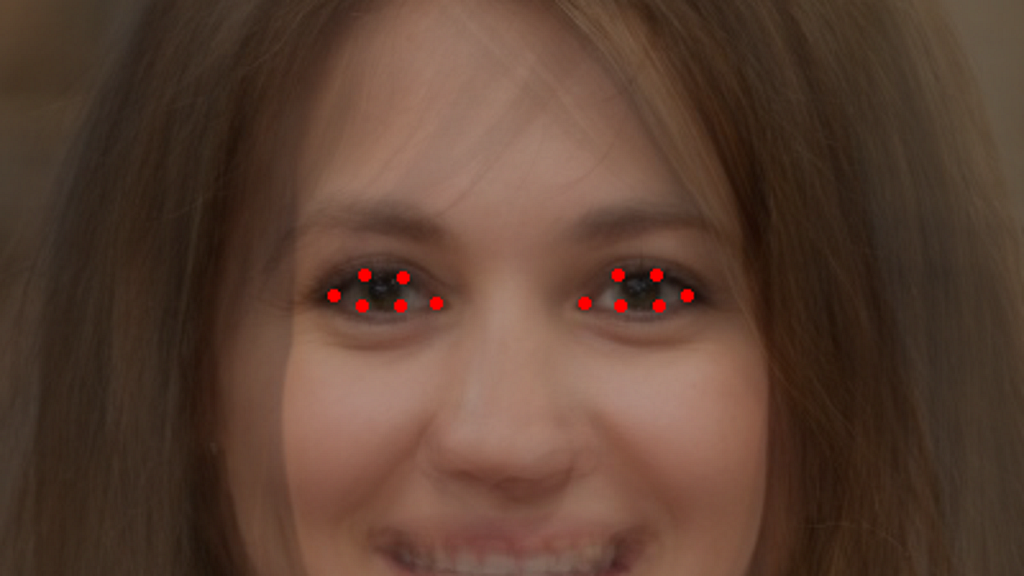
tl;dr — detect the position of the eyes in a photo and measure the distance from them to the mean stylegan2 generated eyes. The likelihood of being an unmodified stylegan2 image can be determined from this distance. These artifacts are specific to StyleGAN2, which is widely used.
From the previous post we have seven different profile photos suspected of being generated by a GAN. These profile photos are all different, yet remarkably similar in some ways. One of the things you might notice from a glance is the consistency in the framing of the face. More specifically the eyes, nose and mouth all seem to be in roughly the same place in each image.
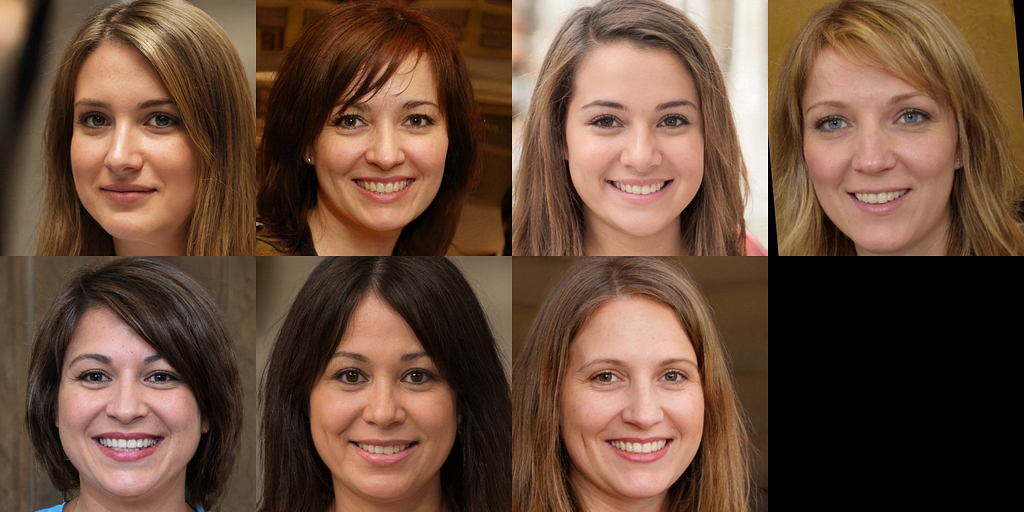
If we take all the profile photos and blend them into a single composite photo, can see that despite differences in hair, mouth and angle of the face, all of the images have eyes in almost exactly the same location.
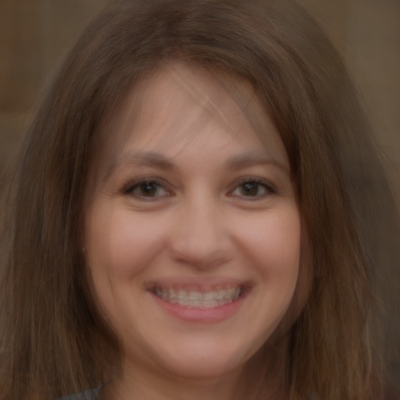
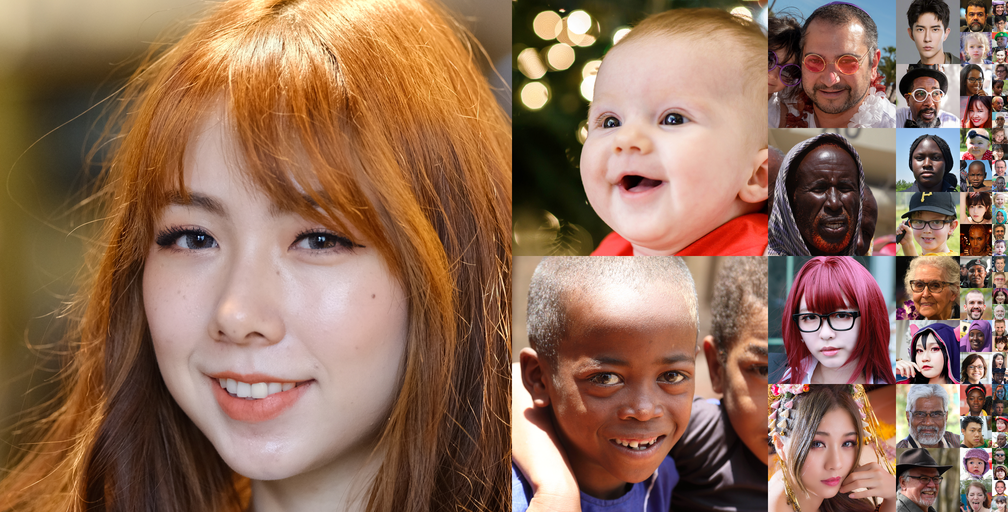
To better understand why this symmetry seems to occur in these StyleGAN2 generated images we will need to understand a little bit about how the GAN is trained. It appears that these images were generated with a specific pre-trained StyleGAN2 network that is considered to produce the most realistic human faces — stylegan2-ffhq-config-f. This model trains on the Flickr-Faces-HQ (FFHQ) dataset at a resolution of 1024×1024. One of the prerequisites of this model is that all of the training photos must be aligned by cropping, centering and putting each face at almost exactly the same location. This allows the algorithm to focus on learning how to make realistic faces. Here is the FFHQ example of some of the photos in the training dataset.
How can we be sure that stylegan2 produces the exact symmetry and locations seen in the LinkedIn profiles? In a colab notebook I’ve used the pre-trained StyleGAN2 model to create 10 new faces, highlighted the eyes in each photo, then run a line across all of the images. This highlights the perfect vertical alignment of the eyes across 10 random photos.

We can further confirm this by looking at the distribution of values for our detected eyes in 1,000 stylegan2 generated photos. In this code snippet I generate 1,000 random faces, get the coordinates of the eyes using Dlib 68 point facial monument detection and look at the distribution of those points. The standard deviation (in pixels) for each point is less than 2px!
num_imgs = 1000
batch_size = 10
rnd = np.random.RandomState(1)
z = rnd.randn(num_imgs,512)
imgs = []
for b in np.split(z, num_imgs // batch_size):
    images = Gs.run(b, None, **Gs_kwargs)
    imgs += [
       Image.fromarray(image).resize((results_size, results_size))
       for image in images
    ]
eyes = np.array([get_eyes(x) for x in imgs])
flat_pts = eyes.reshape(eyes.shape[0], eyes.shape[1]*eyes.shape[2])
flat_pts.std(axis=0)
> array([1.70608294, 1.23875381, 1.22704482, 1.39556404, 1.32981202 1.26775352, 1.2130948 , 1.35359928, 1.20066648, 1.40046278, 1.30262466, 1.29201819, 1.18665538, 1.30560293, 1.31577506, 1.28433485, 1.21646003, 1.39095327, 1.82577545, 1.35985146, 1.38073567, 1.1874001 , 1.24641847, 1.3204166 ]),
Now for the detection part — if we want to know how close an image is to StyleGAN2 we can detect the eyes and measure the distance between the average GAN face and the current face. To get the distance between all the points from the mean, we can use the sklearn pairwise_distance function, which computes the Euclidean distance. Running this on our GAN photos shows the mean distance is about 6px with a standard deviation of 3. Images with a distance between 0–12 are good candidates for being GAN generated or machine aligned.
# compute the distances between all of the points and the mean point
mean_eyes = flat_pts.mean(axis=0).reshape(12, 2)
pairwise_distances(mean_eyes.reshape(1,24), flat_pts[:100])
array([[ 5.65304767, 5.45627602, 3.88290458, 5.36758307, 8.08609597 10.08389548, 5.13331745, 5.18699798, 6.96856858, 5.73174912, 3.15324404, 4.27632412, 3.26357902, 6.49268419, 8.80562025,
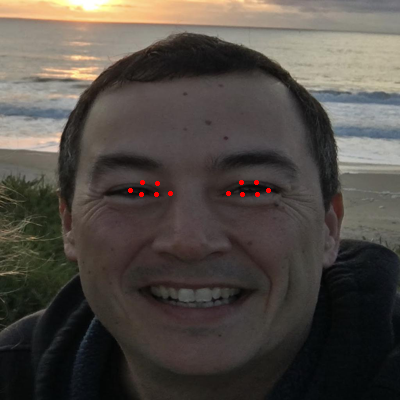
At this point, it seems like finding the eyes and getting the distance from StyleGAN2 is a possible way to do detection, but what about false positives? Is it possible someone just happens to crop their photo just right? We certainly expect aligned photos such as those used to train StyleGAN to be close. For normal user content it’s not as clear. I took one of my own photos, cropped and tried to eyeball the exact right coordinates. You can see in the image below I got really close, but I’m ever so slightly off. More importantly the dimensions of my face aren’t quite the same as the StyleGAN2 faces. I have overlayed the mean of the eyes from the GAN photos for reference.
Now let’s compute the distances for our original LinkedIn profile photos (and one real for reference). Note how the scores are in the range we expect of 0–12, except for the first profile photo. We can see our real profile photo scores a 40, well outside the expected range.
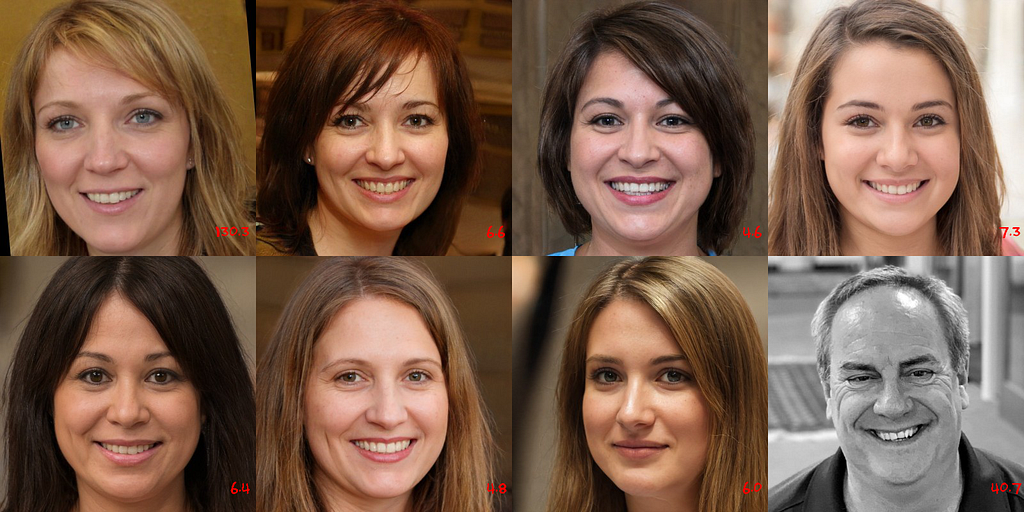
So what happened with the first photo? We believe it is likely to be a GAN but somehow the distance is 130? If you look closely at the image you can see the lower left and upper right contain a diagonal black line. It appears someone attempted to rotate the image, potentially to evade simple detection mechanisms like this. Rotating the image 7 degrees gets the score back under 12.
Conclusion
Using StyleGAN2 alignment artifacts can be an effective way to detect the use of unmodified images. These images appear to be used in LinkedIn profiles and other social media for deceptive purposes. This detection method is not resilient to image modifications and does not apply to non-aligned models like StyleGAN3. Nonetheless this approach has been effective in quickly triaging GAN images and making it easier to hunt for potentially fake Linkedin profiles.